Showing posts with label grandparents. Show all posts

Monday, July 16, 2012

Numbers Game

Mang D used to work in my grandmother’s coconut farm. He was an expert at climbing the tallest coconut trees and usually got top pay for bringing in the most coconuts for copra production. A cheerful fellow, he was well liked by many.

One day he was invited to take a swig of some tuba (fermented coconut water) by the men who frequented the local watering hole (sari-sari store). Unknown to Mang D, a pill was mixed in with the tuba. Before long, Mang D felt strange and he noticed the quickening of his heartbeat. He thanked his generous host and went off to the direction of his house.

While on his way, he noticed that there was a beautiful bird singing up high a coconut tree. It was as if the bird was calling to Mang D. Without a second thought, he climbed up the coconut tree.

The next thing he knew, he was on the ground and wringing in pain. Luckily, a neighbor happen to pass by. Noticing that there was something terribly wrong with Mang D, the neighbor went off to get help.

When asked what he was doing climbing an electrical post, Mang D could only shake his head. Everything was a blur for Mang D. He had burned both hands.


In order to save Mang D, the doctors had to cut off both arms. The right arm was cut just below the elbow. While the left was cut closer to his shoulder.


That was several years ago. Mang D can no longer climb coconut trees but he has found another source of income. He goes around the barangay taking in bets for the local numbers game popularly known as Masiao. Bettors reach into his shirt pocket for the neatly folded paper and pen to write their number combination. They then place their bet in the right pocket of his pants.

Life goes on for Mang D.


-------------------------------------------------------------------
Masiao, the illegal numbers game, is alive and well in Leyte and many parts of the Visayas. A bet of P1 on a three number combination can mean a kilo of rice the next day—if one is lucky. The problem is that kilo of rice may be long in coming if one does not have the winning combination.

And so it goes in many barangays in the city and in the rural areas. Stories of large winnings fan the gambling flame. This is an addiction that is hard to beat when hope for a better life is just a P1 away.

--------------------------------------------------------------------
On a lucky day, a hearty meal for many rural folks consist of a can of sardines. To extend the amount of serving, vegetables, noodles or an egg is added. But on a bad day, a meal could mean day-old rice and ginamos. Ginamos or bagoong is tiny fermented fish.


But to me, it’s always a lucky day when ginamos is present in any meal. Served plainly with a dash of calamansi and it’s a dipping sauce for fried meat or boiled green bananas. It can add life to stewed vegetables or the perfect addition to sautéed trio of tomatoes, onions and garlic.


It’s a numbers game when guessing how much rice you will end up eating when you have ginamos--- plain or fancy.


Sunday, February 26, 2012

Family Beginnings

It’s five in the afternoon and my mother has my undivided attention. I have heard her tell the story a hundred times and in each telling a new facet is revealed. And so she tells me one more time the story of her father and mother.

A civil war was brewing in Spain in the 1930s. There was general discord, lack of jobs, unrest, disenchantment. To escape being drafted to fight in a senseless war, my grandfather and two older brothers left their home in Maruri-Jatabe, an agricultural town located in the province of Biscay, in the Basque country of northern Spain. I can only imagine what went on in my grandfather’s mind as he saw the Basque coastline for the very last time. He was 16.

My grandfather and his brothers eventually found their way to the Philippines. For a time, they hired themselves out to oversee the farms of other Basque compatriot who had established themselves in rural Leyte. In one such employment, my grandfather, at 23 was sent off to far flung Taglawigan, San Isidro, Leyte. By that time, not only was my grandfather busy with farm management but was also kept occupied with several romantic liaisons. For what is a lonesome Basque to do so very far from home.

Then one day, a 15 year old provincial lass caught his Castilian eye. She was the daughter of his "labandera" and eventually, would become his wife--- my grandmother. I can only imagine what went on in my grandmother’s mind as she bid her mother and father good-bye to live with a man she hardly knew anything about.

In a span of 17 years, my grandmother gave birth to 10 children—one dying at infancy and the rest living through the cruelties of World War 2; the struggles that characterized poor rural life; and, eventually in later years, gaining the comforts afforded by determination and hard work.

A compassionate woman, my grandmother accepted into her home and heart four other children earlier begotten by my grandfather with several women. They were treated like her own and they in turn addressed her as “Ma”.

My grandparents eventually settled way up in the mountains of Catagbakan, Villaba, Leyte.


At that time, it was the farthest place from civilization—as how my mother described it. Oh, the hardships my mother and her siblings had to go through just to attend classes at the nearest school. It was a two to three hour muddy trek by foot to town. At night, a few “gaseras” were their source of light until it was “lights out” at 8 in the evening and time to rest.


My grandfather never returned to his homeland and I was told that in fits of lonely remembrance, would cry as he sat in the balcony in the early evenings. I can only imagine what went on in the minds of his children as they looked on at the sad scene.

My grandfather died at 60 of blood poisoning as a result of an ear infection. Medical attention was not available so far, far up in the mountains. My grandmother lived on well into her 80s—20 years of which she served as Barangay Captain. She was well loved by the rural folks and is remembered to possess a gentle but firm demeanor.

My grandfather and grandmother were simple folks who lived during turbulent times, and to my mind, chose to live extraordinary lives. They are now buried in a plot that is a short walk from their house-- on the land that they and their children literally poured all their energies in order to survive.


Every family has a story to tell and I believe these stories have to be told and re-told. For in their telling, there is eventual understanding of self and the appreciation of the ties that bind family members to each other.

--------------------------------------------------------------

No family story is complete without mention of food. Especially food that brought comfort and remembrance. Just like my grandparents, the following recipe is simple but packed with flavor. My mother says that this was a favorite of my grandfather. I am sure this will make it to your list of favorite dishes once you give it a try.

Grilled Fish with Garlic Vinegarette

1 kilo fish (preferably tuna or tanguigui) seasoned with salt and pepper and grilled until cook. Be sure not to overcook the fish so that the flesh will not dry out. Set aside on a platter.

Heat about ¼ cup of olive oil in a small skillet over medium heat. Add sliced garlic (about 2 tablespoons). Cook until golden. Remove from fire and add about half a teaspoonful of pepper flakes (optional) and about 2-3 tablespoons of vinegar. Take care when adding the vinegar as this may cause the oil in the skillet to flare up. Stir until sauce is blended. Spoon the resulting sauce over the fish. Serve immediately.

Tuesday, February 21, 2012

Good Morning Katagbakan

It's already past six in the morning and the temperature continues to be chilly in my grandparents’ (mother side) farm.


There are tiny dew drops on every leaf in the surrounding garden. An early venture out of the house meant coming back with wet slippers and toes.

When I was so much younger, I remember my uncles getting ready to check on the farm right after drinking a cup of steaming coffee. That was at 4:30AM! Now that they are in their 80s, they take their sweet time swapping stories on the balcony and wait for trusted workers to come over to the house with crop and cattle report later in the morning.


The kitchen is slowly filling up with the sweet smell of burning wood as preparations for breakfast gets underway.


Soon there erupts a combination of squeak and squeal from the pigpens and the cackle of chickens as they anticipate the approach of a younger uncle with their morning meal.


The floors are quickly given a good sweep and the contents of bedpans quickly disposed of.


Before long, a hearty breakfast is ready and a call goes out through the house for everyone to come to the table before the food gets cold.


My grandparents are no longer around but I still feel their presence-- specially my grandmother. She's watching over us as we share stories of time past, present concerns and plans for tomorrow.

------------------------------------------------------------

Just recently, I asked the origin of the name “Katagbakan”-- the name given to the area where my grandparents’ farm is located. I was promptly shown the “tagbak” plant that grow all over the area. (Tagbak is a stout herbaceous plant growing to a height of 2 to 4 meters, with stout rootstocks).


------------------------------------------------------------

A lot of meals have come out of my grandmother’s kitchen. A gas stove and oven had been installed sometime ago but it seldom is put to use. Instead, a wood-burning, three burner iron stove continues to be the work horse of choice.

Many outside help have been employed to do kitchen duties. Their number would swell during celebrations. At present and for the last 10 years, “Ibyang” has taken on the task of coming up with daily meals for my aunt and uncle and the occasional visitor. Although physically challenged at a height below 4 feet, she manages to cook up a storm on the iron stove while standing on a small stool. Because of her happy disposition and infectious laughter, one would not know of the many heartaches and hardships she continues to face. Putting on a wide smile and with pride, she comes out of the kitchen with dishes taught her by my aunts. Recipes of which were handed down by my grandmother.

Below, are just some of dishes she prepared while I was visiting. Unfortunately, she could not give me exact measurements as everything is by “feel” and ingredients added on to taste. Surely a good reminder to live life with spontaneity rather than following a step by step measured plan.

Sliced Eggplant with Minced Pork


4-5 eggplants, sliced
About ¼ kilo of pork, minced
Sliced Garlic & Onion
Soy sauce
Salt and pepper

Soak sliced eggplants in water with a little salt. In a wok, sauté the garlic and the onion. Add the minced pork and continue to cook. Drain the eggplants and add to the wok. Add soy sauce, salt and pepper. Soy sauce should be an amount that would bring the dish to a uniform brown color. Serve with lots of steaming rice.

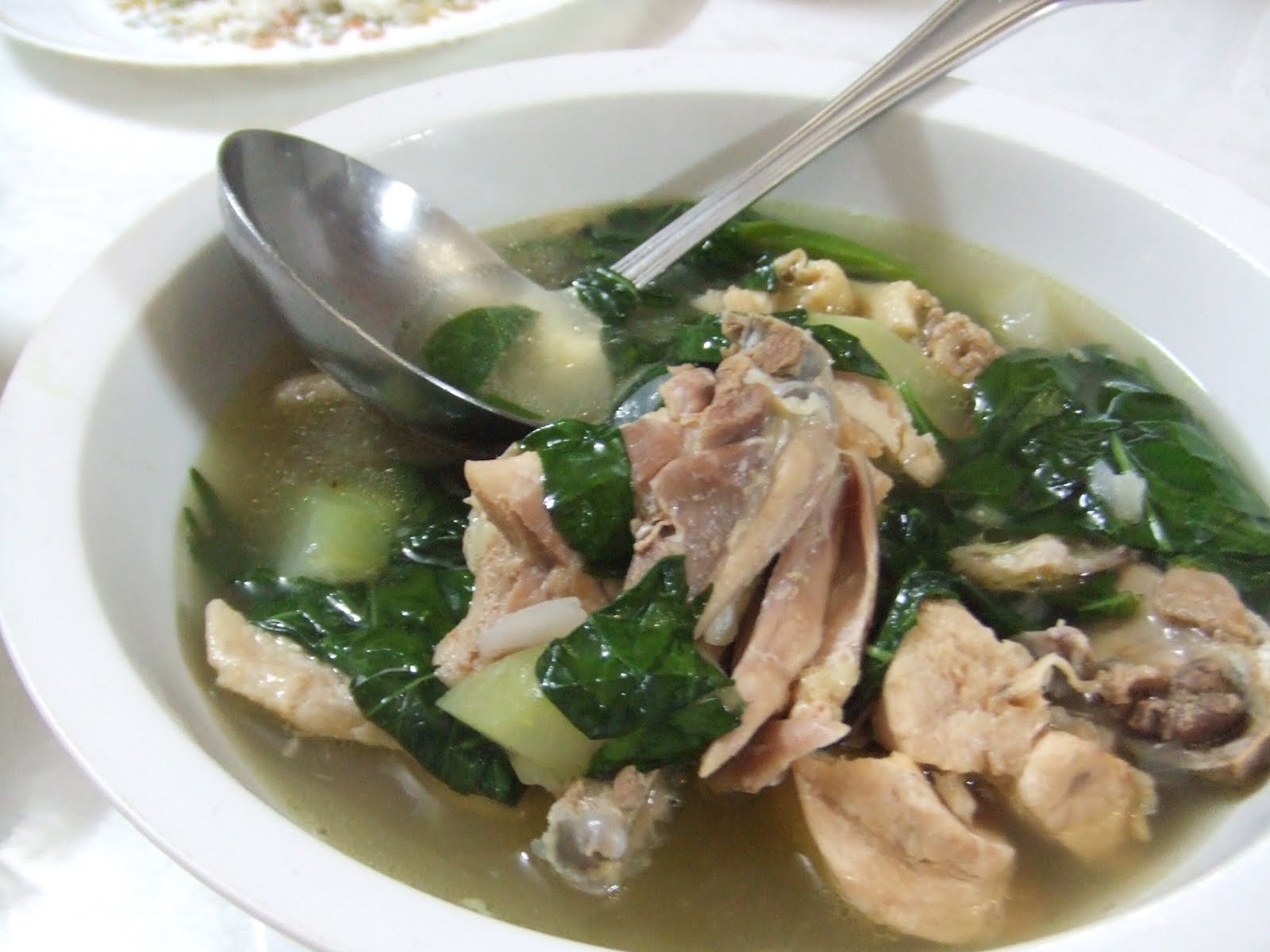
Native Chicken Tinola


1 native chicken, cut into serving pieces
Tanglad
Sliced Ginger, garlic & onion
sili leaves
Small green papaya, peeled and sliced
Salt and pepper

Boil the native chicken in plenty of water. Add the tanglad, ginger, garlic and onion. It’s tough so this will take some time to become tender. Lower heat to a simmer. When chicken is tender, add the sliced green papaya. Cook until papaya is tender but not mushy. Add the sili leaves, salt and pepper. Turn off heat when leaves start to wither. Serve hot with lots of rice.

Pata with Kangkong


1 pork pata, sliced
Tanglad
Sili espada
Garlic
Onion
A bunch of kang kong
Salt & pepper

Put pata in a pot and cover with water. Bring to a boil and immediately throw out the resulting broth. Return pot to the stove and add new water. Add garlic, onion and tanglad. Bring to a boil then lower heat to a simmer. Continue cooking until pata is tender. Drop the kangkong leaves; sili espada; add salt and pepper to taste. Turn off heat when kang kong leaves have withered somewhat. Serve hot with lots of rice and a side of fried dried fish (daing).

Roasted Eggplant with Coconut Cream


4-5 eggplants, roasted and sliced up after burnt peel remove
Sliced Ginger, tomatoes and onion
Sliced Green onions or leeks
Coconut cream (the 1st squeeze from grated coconut)
Salt and pepper

Place the sliced roasted eggplant in a bowl together with the sliced ginger, onions, tomatoes, green onions, coconut cream, salt and pepper. Toss around until everything is well coated with the coconut cream. Chill before serving. Best served with grilled meat or fish.